
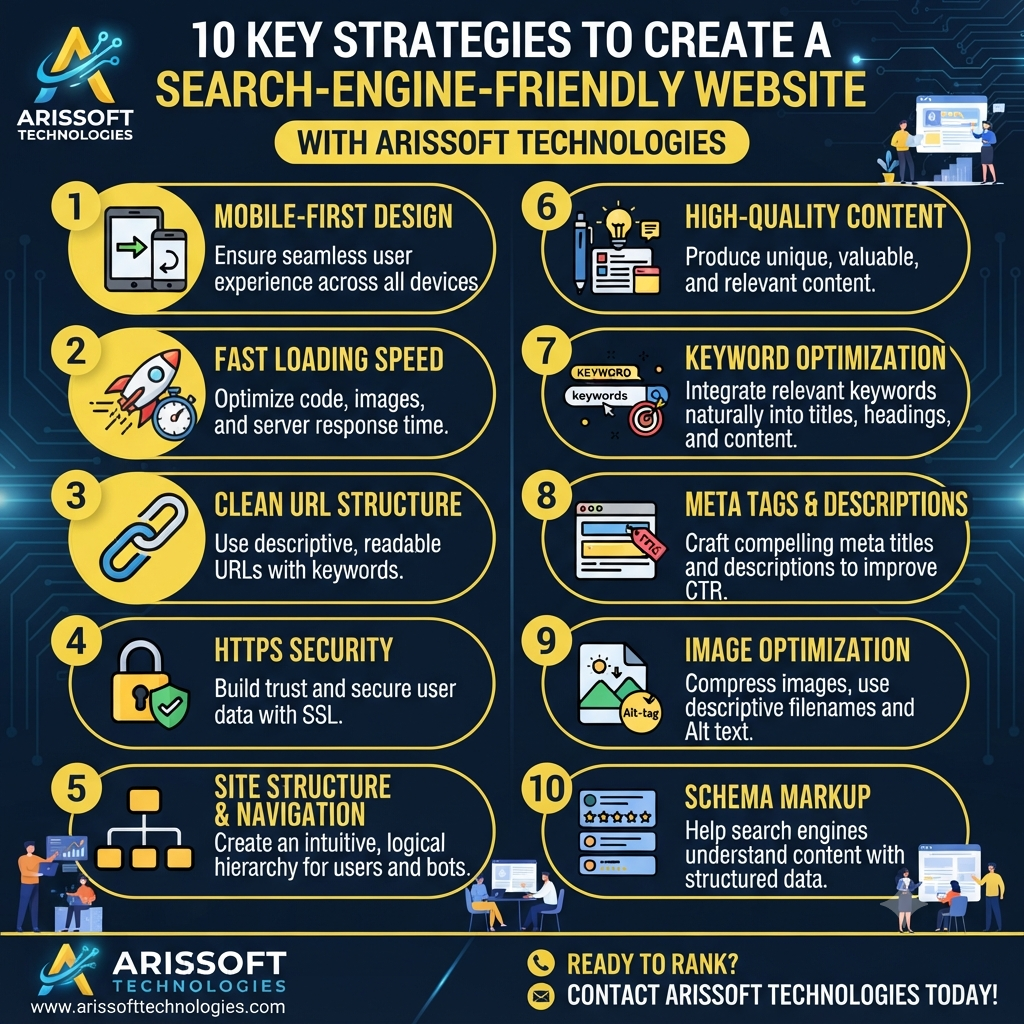
A website is more than an online presence. It is an important part of your digital marketing strategy. A well-structured, fast, useful, and search-engine-friendly website can help your business appear higher on Google, attract relevant visitors, and generate more enquiries.
Search engines look at many factors when deciding which pages should appear in search results. These include website structure, content quality, page speed, mobile usability, technical SEO, keywords, links, and user experience.
Here are 10 key strategies to create a search-engine-friendly website.
A good website should be easy for both visitors and search engines to understand.
Organize your website into clear sections and categories. Important pages should be easy to reach from the main navigation.
For example, a digital marketing company may have:
A logical structure helps search engines discover and understand your pages more efficiently.
Keywords help search engines understand what your page is about.
Before creating content, identify the terms your potential customers are searching for. Focus on keywords that are relevant to your services, location, and target audience.
For example, a local agency may target terms such as:
Avoid adding keywords unnaturally. Use them where they make sense in headings, page content, URLs, titles, and descriptions.
High-quality content is one of the most important parts of a search-engine-friendly website.
Your content should answer real customer questions and provide useful information. Avoid copying content from other websites or creating pages only to target keywords.
Good website content should be:
Use short paragraphs, clear headings, bullet points, examples, and practical information to make content easier to understand.
Every important page should have a unique and descriptive title.
The page title tells search engines and users what the page is about. A well-written title can also encourage people to click your result.
For example:
SEO Services in Noida | Arissoft Technologies
A meta description should briefly explain what visitors can expect from the page.
While meta descriptions are not a direct ranking factor, a clear and relevant description can improve the appeal of your search result.
Many people browse websites using smartphones. Therefore, your website should work properly on mobile devices, tablets, and desktops.
Check that:
A responsive website provides a better experience for users and supports your overall SEO performance.
Website speed matters because visitors do not want to wait for a slow page.
Large images, unnecessary scripts, poor hosting, and excessive plugins can slow down a website.
To improve performance:
You can use Google's PageSpeed Insights to identify performance issues and opportunities for improvement.
7. Create SEO-Friendly URLs
Your URLs should be short, descriptive, and easy to understand.
For example:
example.com/seo-services-noida
is easier to understand than:
example.com/page?id=4587
Use relevant words in URLs and avoid unnecessary numbers, symbols, and complicated structures.
A clean URL also makes it easier for users to understand what they will find on the page.
8. Use Proper Headings and Content Formatting
Headings create a clear structure for your content.
Use one main H1 heading for the primary topic and use H2 and H3 headings to organize supporting sections.
For example:
H1: SEO Services for Doctors
H2: Why Doctors Need SEO
H2: Benefits of SEO for Clinics
H3: Improve Local Visibility
This structure helps visitors scan the page and gives search engines useful information about the content hierarchy.
9. Build Internal and High-Quality External Links
Links help search engines discover and understand relationships between pages.
Internal links connect pages within your own website. For example, a blog about local SEO can link to your local SEO service page.
You should also earn relevant backlinks from trustworthy websites. Quality is more important than simply collecting a large number of links.
Avoid buying low-quality backlinks or participating in link schemes. These practices can create SEO problems instead of improving rankings.
10. Focus on Technical SEO and Regular Monitoring
Technical SEO helps search engines crawl, understand, and index your website.
Important areas include:
You should also regularly monitor your website using tools such as Google Search Console and analytics platforms.
SEO is not a one-time activity. Search trends, competitors, website technology, and search-engine systems change over time. Regular monitoring allows you to identify problems and improve your website.
Why a Search-Engine-Friendly Website Matters
A search-engine-friendly website can provide several benefits for a business.
Better Search Visibility
A properly optimized website has a stronger foundation for appearing in relevant search results.
More Relevant Website Traffic
Targeting the right keywords and creating useful content can help attract people who are genuinely interested in your products or services.
Better User Experience
Fast loading pages, simple navigation, mobile compatibility, and useful content make it easier for visitors to find what they need.
More Business Enquiries
When the right users reach the right pages, your website has a better opportunity to generate calls, enquiries, bookings, or sales.
Long-Term SEO Growth
Unlike short-term promotional campaigns, SEO can continue bringing organic traffic as your website builds useful content, authority, and visibility over time.
Common SEO Mistakes to Avoid
While optimizing your website, avoid these common mistakes:
The goal should always be to create a website that is useful for people first while making it easy for search engines to understand.
Final Thoughts
Creating a search-engine-friendly website requires more than adding keywords to your pages. You need a combination of quality content, technical SEO, mobile optimization, fast performance, clear navigation, strong website structure, and regular monitoring.
Start with the basics and improve your website step by step. When SEO and user experience work together, your website can become a stronger source of organic traffic, leads, and long-term business growth.
 Digital Marketing Service in Noida: How to Choose the Right Services for Your Business
 How to Find the Best Digital Marketing Company in Noida: A Complete Business Guide
 Top 5 Leading Digital Marketing Companies in Noida for Business Growth
 Top Benefits of SEO Services – Boost Your Online Presence and Business Growth
 Why Local SEO Is Important for Small Businesses
 How Startups Can Use Local SEO to Increase Visibility and Get More Leads

.jpg)