
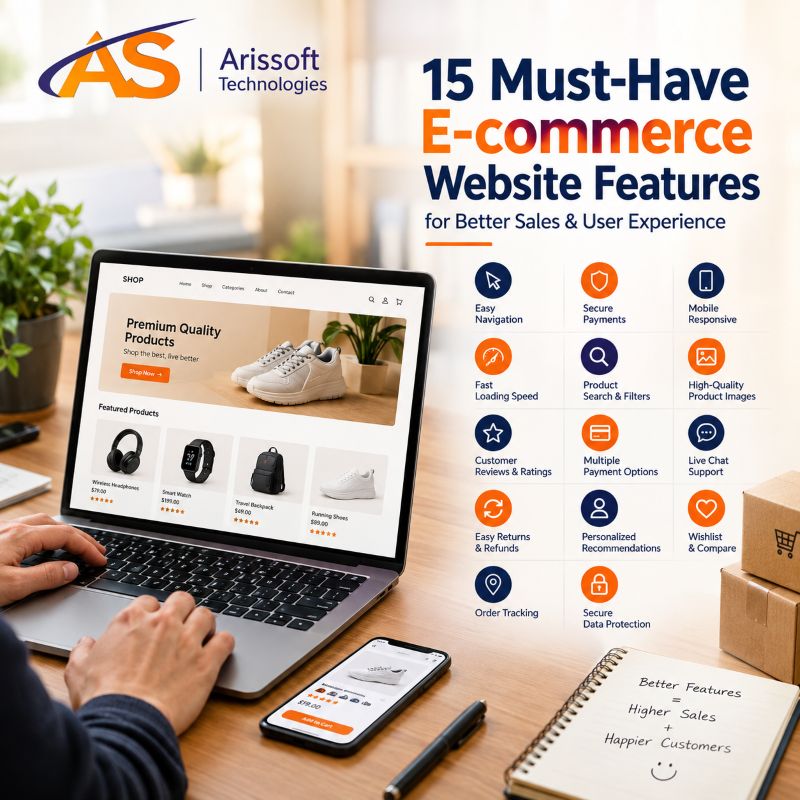
An e-commerce website is more than an online product catalogue. It is a complete digital shopping experience where customers discover products, compare options, make payments, and track their orders.
A well-designed e-commerce website Development Company can help businesses attract more visitors, build trust, increase conversions, and generate repeat purchases. On the other hand, a slow, confusing, or difficult-to-use website can make customers leave before completing their purchase.
Whether you are launching a new online store or improving an existing one, the following 15 e-commerce website features can make a significant difference to sales and user experience.
A large number of customers browse and shop using smartphones. Therefore, your e-commerce website should work smoothly on mobile devices, tablets, laptops, and desktops.
A responsive website should automatically adjust:
Make sure buttons are easy to tap and important information is visible without excessive scrolling.
Mobile-friendly design is essential for providing a consistent shopping experience across devices.
Website speed can directly affect the shopping experience. Customers generally do not want to wait for product pages, images, or checkout screens to load.
A faster website can help reduce frustration and unnecessary page abandonment.
You can improve website speed by:
Speed optimization should be considered an important part of both e-commerce development and SEO.
Customers should be able to find products without struggling through complicated menus.
Create clear categories and subcategories based on how customers search for your products.
For example:
Men → Clothing → Shirts → Formal Shirts
Useful navigation can include:
A simple navigation structure helps visitors move from browsing to purchasing more easily.
If your store has hundreds or thousands of products, search functionality becomes extremely important.
An effective e-commerce search feature should allow customers to quickly find what they need.
Consider adding:
For larger stores, advanced search can save customers considerable time.
The product page is one of the most important parts of an online store.
Customers cannot physically touch or inspect products online, so your product page needs to provide enough information to support their buying decision.
A strong product page can include:
Use clear and easy-to-understand language instead of filling the page with unnecessary information.
Visual content plays an important role in online shopping.
Customers want to see what they are purchasing from different angles. High-resolution images can help them understand the product better.
Where appropriate, include:
However, large image files can slow down your website, so images should be properly optimized before uploading.
Customers often look for other buyers' experiences before making a purchase.
Adding customer reviews and ratings can provide useful product information and social proof.
A review section can include:
Businesses should also make it easy for genuine customers to leave feedback after receiving their orders.
Filters are especially useful for stores with a large number of products.
Depending on your industry, customers may want to filter products by:
For example, someone searching for shoes may want to select a particular size, colour, brand, and price range.
Effective filtering helps customers reach relevant products faster.
Security is essential for an e-commerce website SEO because customers may provide personal information, addresses, and payment details.
Your website should use HTTPS and follow appropriate security practices.
Important security measures can include:
Displaying appropriate trust and security information can also help customers feel more comfortable during checkout.
Customers have different payment preferences. Providing several reliable payment methods can make checkout more convenient.
Depending on your target market, you can offer:
Payment options should be presented clearly and integrated with trusted payment gateways.
A complicated checkout process can create unnecessary friction.
Try to keep the checkout process simple and ask only for information that is actually required.
A good checkout experience can include:
Helpful features include guest checkout, saved addresses, clear delivery charges, and transparent pricing.
Avoid surprising customers with unexpected fees at the final stage.
A shopping cart allows visitors to collect products before purchasing them.
A wishlist goes one step further by allowing customers to save products for later.
Useful features include:
These features can be particularly useful when customers are researching products before making a final decision.
Customers want to know when their order will arrive and what happens if they need to return it.
Your website should clearly explain:
Avoid hiding important information in difficult-to-find pages.
Clear policies can improve transparency and reduce customer confusion.
After completing an order, customers want to know its status.
An account dashboard can allow customers to:
Real-time or regularly updated order tracking can provide customers with greater visibility after purchase.
A beautiful e-commerce website will not generate consistent organic traffic if search engines cannot properly discover and understand its pages.
An SEO-friendly e-commerce website should have:
For example, instead of a confusing URL, use a descriptive structure such as:
/mens-running-shoes/
rather than a URL containing unnecessary parameters.
E-commerce SEO can help product and category pages become more discoverable in search engines.
The 15 features above form a strong foundation, but modern online stores can also benefit from additional functionality.
Show customers products based on browsing behaviour, previous purchases, or related products.
For example:
You May Also Like
or
Frequently Bought Together
Live Chat and Customer Support
A live-chat option can help customers get answers about products, delivery, payments, and returns before purchasing.
Abandoned Cart Recovery
Some customers add products to their cart but leave without completing the purchase.
Email, SMS, or other permitted remarketing methods can remind customers about abandoned carts, subject to applicable privacy and communication requirements.
A flexible coupon system can support:
Analytics and Reporting
Analytics help store owners understand how visitors interact with the website.
Important metrics can include:
This information can help businesses identify areas that need improvement.
These features work together rather than independently.
For example, imagine a customer searching for a product on Google. They land on a fast, mobile-friendly product page with clear images, reviews, pricing, shipping information, and an easy-to-use Add to Cart button.
They can then:
Search → Discover → Compare → Trust → Add to Cart → Checkout → Pay → Track Order
Every step should be simple and transparent.
The objective is not to add as many features as possible. The objective is to remove unnecessary friction from the customer's buying journey.
|
Feature |
Main Benefit |
|
Mobile-friendly design |
Better mobile shopping experience |
|
Fast loading speed |
Less waiting and friction |
|
Clear navigation |
Easier product discovery |
|
Product search |
Faster access to products |
|
Detailed product pages |
Better purchase information |
|
Images & videos |
Stronger product presentation |
|
Reviews & ratings |
Customer trust and social proof |
|
Product filters |
Easier product comparison |
|
Website security |
Safer shopping experience |
|
Multiple payments |
Greater payment convenience |
|
Simple checkout |
Reduced checkout friction |
|
Cart & wishlist |
Easier purchase planning |
|
Shipping & returns |
Greater transparency |
|
Order tracking |
Better post-purchase experience |
|
SEO-friendly structure |
Better organic discoverability |
A successful e-commerce website SEO Agency needs to do more than display products. It should make the entire customer journey simple—from discovering a product to completing payment and tracking the order.
Features such as mobile responsiveness, fast loading speed, detailed product pages, reviews, advanced search, secure payments, simple checkout, order tracking, and SEO-friendly architecture can create a better foundation for online sales.
If you are planning to build or redesign an e-commerce website, focus first on speed, usability, trust, security, and a smooth buying journey. Once these fundamentals are strong, advanced features such as personalization, automation, AI-powered recommendations, and advanced analytics can be added according to your business requirements.
 Digital Marketing Service in Noida: How to Choose the Right Services for Your Business
 How to Find the Best Digital Marketing Company in Noida: A Complete Business Guide
 Top 5 Leading Digital Marketing Companies in Noida for Business Growth
 Top Benefits of SEO Services – Boost Your Online Presence and Business Growth
 Why Local SEO Is Important for Small Businesses
 How Startups Can Use Local SEO to Increase Visibility and Get More Leads

.jpg)