
Digital marketing has become an important part of student recruitment for schools, colleges, universities, coaching institutes, and education consultants. Students and parents now use Google, social media, YouTube, and other online platforms to research courses and institutions before making an admission decision.
However, simply spending money on online advertising agency does not guarantee results. Educational institutes need a clear digital marketing strategy that focuses on quality leads, admissions, brand visibility, and measurable returns.
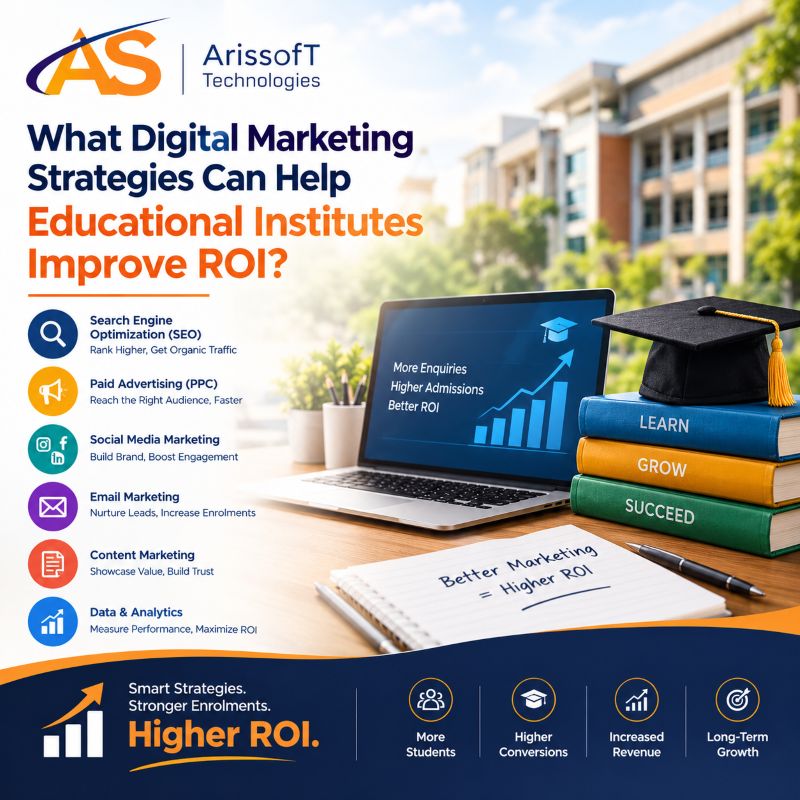
So, what digital marketing strategies can help educational institutes improve ROI? Let us understand the most effective approaches.
ROI, or Return on Investment, measures how much value an educational institute receives from its marketing investment.
For example, if an institute spends ?1 lakh on digital marketing and generates admissions worth ?5 lakh, the campaign has produced measurable revenue against the marketing cost.
A simple way to understand marketing ROI is:
ROI = (Revenue Generated – Marketing Cost) ÷ Marketing Cost × 100
For educational institutes, ROI should not only be measured through website traffic or social media likes. More useful metrics include:
Search Engine Optimization (SEO) can help educational institutes attract students who are actively searching for courses, colleges, universities, and admission information.
For example, an institute may target keywords such as:
A strong SEO strategy should include:
SEO can be particularly useful for long-term lead generation because a well-optimized page can continue attracting organic visitors after the initial content investment.
Many educational institutes make the mistake of sending all advertising traffic to their homepage.
A better approach is to create dedicated landing pages for individual courses and admission campaigns.
For example:
Google Ad → MBA Admission Landing Page → Enquiry Form → Counselling → Application → Admission
A good landing page should clearly explain:
The page should answer the student's main questions without making them search through multiple sections of the website.
Google Ads can help educational institutes reach users who are already searching for admission-related information.
Examples include:
Search advertising can be useful because the audience is already expressing an interest through a search query.
However, campaigns should be carefully managed.
Educational institutes should monitor:
Instead of focusing only on getting a large number of leads, institutes should identify which campaigns are generating genuine enquiries and admissions.
Students spend considerable time on social platforms. This makes social media marketing for educational institutes an important part of a digital strategy.
Platforms can be used to share:
Social media should not be used only for promotional posts. Useful and informative content can help build trust with prospective students and parents.
Facebook and Instagram advertising can help institutes reach specific audience segments based on factors such as location and interests.
Educational institutes can create campaigns for:
Lead forms can make it easier for interested students to submit their contact details.
However, lead quantity should not be the only goal. The admissions team should check the quality of leads generated from each campaign.
Video is highly useful for education marketing because students and parents often want to understand the institute before making an enquiry.
Educational institutes can create videos such as:
YouTube can also support SEO because videos can appear in search results and provide another way for prospective students to discover an institution.
Students have many questions before applying to a course.
For example:
Creating helpful content around these questions can attract relevant organic traffic.
A good education content strategy can include:
The content should provide useful information rather than simply repeating promotional messages.
For institutes targeting students from a specific city or region, local SEO agency Near Me can be valuable.
An institute can optimize its Google Business Profile and website for relevant local searches.
Examples include:
College in Noida
MBA college in Delhi
Coaching institute in Gurgaon
Local SEO activities can include:
Local visibility can help institutes attract students searching for education options in a specific area.
Not every website visitor submits an enquiry during their first visit.
A student may visit a course page, compare several institutes, and return later before making a decision.
Remarketing campaigns can help educational institutes reconnect with previous website visitors, where platform policies and applicable consent requirements allow it.
For example:
Student visits MBA page → Leaves website → Sees relevant reminder advertisement → Returns → Submits enquiry
Remarketing should provide useful information rather than repeatedly showing the same advertisement.
Generating leads is only one part of education marketing.
The next challenge is converting those leads into applications and admissions.
A CRM system can help admissions teams organize enquiries and track their progress.
A typical process may look like:
New Lead → Contacted → Counselling Scheduled → Interested → Application Started → Application Submitted → Admission
WhatsApp, email, phone calls, and SMS can also be used for appropriate follow-ups.
Fast and organized communication can reduce the chances of losing genuine enquiries.
One of the biggest problems in digital marketing is measuring only the top of the funnel.
For example:
10,000 website visitors
may sound impressive, but what matters is how many of those visitors become enquiries and admissions.
Educational institutes should track:
Traffic → Leads → Qualified Leads → Counselling → Applications → Admissions → Revenue
This provides a clearer picture of marketing performance.
Suppose Campaign A generates 500 leads at ?100 per lead, while Campaign B generates 100 leads at ?300 per lead.
At first glance, Campaign A appears cheaper.
But if only 2 students from Campaign A enrol while 15 students from Campaign B enrol, the second campaign may produce better business results.
Therefore, institutes should monitor cost per admission, not only cost per lead.
This is one of the most important principles for improving digital marketing ROI.
Parents and students often research an institution before contacting it.
Positive and genuine reviews can provide additional information about the student experience.
Institutes can encourage eligible students and parents to leave honest feedback.
Useful trust-building content includes:
All claims should be accurate and supported by genuine information.
Marketing automation can reduce repetitive manual work.
For example, when a student submits an enquiry, an automated system can:
Automation does not replace the admissions team. Instead, it can help the team respond consistently and manage a larger number of enquiries.
Digital marketing should not be treated as a one-time activity.
Educational institutes should regularly test:
For example, changing a landing-page headline or simplifying an enquiry form may affect conversion performance.
The objective should be continuous improvement based on actual campaign data.
A practical approach is to combine multiple strategies rather than depending on a single channel.
A strong education marketing funnel could look like:
SEO + Content Marketing
↓
Google Search + Social Media
↓
Course Landing Pages
↓
Lead Generation
↓
CRM + Counselling
↓
Application
↓
Admission
↓
Revenue
Each stage should be measured separately.
Important KPIs for Education Marketing
Educational institutes can track the following KPIs:
|
KPI |
What It Measures |
|
Website Traffic |
Number of visitors |
|
Organic Traffic |
Visitors from search engines |
|
Leads |
Number of enquiries |
|
Qualified Leads |
Relevant prospective students |
|
CPL |
Cost per lead |
|
Conversion Rate |
Percentage of visitors/leads converting |
|
Applications |
Number of completed applications |
|
Admissions |
Number of enrolled students |
|
Cost per Admission |
Marketing cost for each admission |
|
Revenue |
Income generated from admissions |
Educational institutes should avoid:
Digital marketing can help educational institutes reach prospective students, generate enquiries, build trust, and support admissions. But improving ROI requires more than simply increasing the advertising budget.
The focus should be on the complete student journey—from search and discovery to enquiry, counselling, application, and admission.
A combination of SEO, Google Ads, social media marketing, content marketing, video marketing, landing-page optimization, CRM, remarketing, and conversion tracking can create a more measurable education marketing system.
Most importantly, institutes should regularly analyze which channels generate qualified leads and actual admissions. This allows marketing budgets to be allocated based on measurable performance rather than assumptions.
 Top 5 Leading Digital Marketing Companies in Noida for Business Growth
 Top Benefits of SEO Services – Boost Your Online Presence and Business Growth
 Why Local SEO Is Important for Small Businesses
 How Startups Can Use Local SEO to Increase Visibility and Get More Leads
 How It Works and Why It Matters for SEO.jpg) Search Engine Results Page (SERP): How It Works and Why It Matters for SEO
Search Engine Results Page (SERP): How It Works and Why It Matters for SEO
 Improve Your SEO Strategy with These Simple Schema Markup Tips
.jpg)