
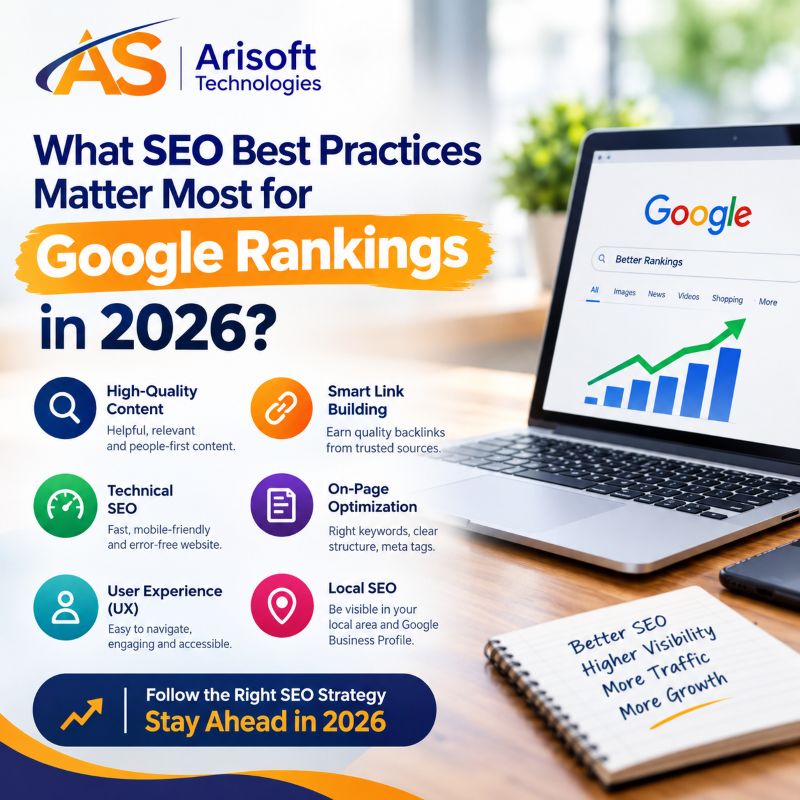
Google search is changing quickly. In 2026, ranking a website is not only about adding keywords to a page. Google looks at many signals to understand whether a website provides useful, reliable, and relevant information to users.
Businesses that want better Google rankings need a complete SEO strategy. This includes helpful content, technical SEO, website performance, user experience, authority, and proper keyword targeting.
If you are trying to improve your website visibility in Google, understanding the most important SEO best practices in 2026 can help you build a stronger long-term strategy.
Search Engine Optimization (SEO) is the process of improving a website so that search engines can understand its content and users can easily find and use it.
Modern SEO agency Noida focuses on more than rankings. A successful SEO strategy should help a business:
Google's systems are becoming better at understanding the meaning and usefulness of content. Therefore, websites should focus on satisfying the user's search intent instead of simply repeating keywords.
Content remains one of the most important parts of SEO.
However, publishing large numbers of low-value articles is not a reliable strategy. Your content should answer real questions and provide useful information to your target audience.
For example, a website offering SEO services could create content about:
The goal should be to provide information that users actually need.
Before publishing an article, ask:
High-quality content can also support internal linking and help build topical authority.
Search intent means understanding why someone is searching for a particular keyword.
For example, someone searching for:
"SEO company in Noida"
may be looking for a service provider.
Someone searching for:
"what is SEO"
is more likely looking for educational information.
These searches have different purposes, so they should not necessarily use the same type of page.
The main types of search intent include:
The user wants information.
Examples:
The user is researching options before making a decision.
Examples:
The user is ready to take an action.
Examples:
The user is trying to find a particular website or business.
Understanding intent helps you create the right page for the right search.
Keywords are still useful, but keyword stuffing can make content difficult to read and may create a poor user experience.
Instead of repeatedly using the same keyword, use related phrases and natural language.
For example, a page targeting SEO Services in Delhi NCR could naturally include related terms such as:
Place your primary keyword naturally in important areas such as:
The keyword should fit naturally into the page rather than being forced into every paragraph.
Publishing one article about a subject is usually not enough to demonstrate broad expertise.
A better approach is to create a group of related content around a main topic.
For example, a website targeting SEO could create a topic cluster covering:
Main Topic: SEO Services
Supporting topics:
These pages can be connected through relevant internal links.
This helps users discover related information and makes the website structure easier to understand.
Technical SEO helps search engines crawl, understand, and index your website.
Important technical SEO areas include:
A website can have excellent content but still experience SEO problems if important pages cannot be properly crawled or indexed.
Website performance affects the user experience.
Visitors do not want to wait several seconds for a page to load. Slow websites can increase frustration and may reduce engagement.
Important areas to monitor include Google's Core Web Vitals, which focus on aspects of loading performance, responsiveness, and visual stability.
To improve website performance:
Performance should be measured regularly rather than assumed.
A large portion of web traffic comes from mobile devices.
Your website should work properly on smartphones and tablets.
Check that:
A good mobile experience is important for both users and search visibility.
Internal links connect one page of your website to another page on the same website.
Good internal linking helps:
For example, an article about local SEO can link naturally to a detailed page about Google Business Profile optimization.
Avoid adding internal links simply for the sake of adding links. Each link should provide value to the reader.
Backlinks are links from other websites to your website.
Quality matters more than simply collecting a large number of links.
A relevant link from a trustworthy website can be more useful than many low-quality or unrelated links.
Businesses can work toward earning backlinks through:
Avoid relying on spammy link-building networks or tactics designed only to manipulate search rankings.
For businesses serving specific cities or locations, Local SEO is extremely important.
A local SEO strategy can include:
For example, a digital marketing agency serving Noida may create useful pages around services and locations such as:
The pages should contain genuinely useful local information rather than simply repeating the city name.
People want to know whether they can trust the information they are reading.
Websites should make it clear who is behind the content and why the business or author is qualified to discuss the subject.
Useful trust signals can include:
For business websites, transparent information can help visitors make more informed decisions.
Structured data provides search engines with additional information about certain types of content.
Depending on the website, relevant structured data may include information for:
Structured data does not guarantee higher rankings or rich results. It should be implemented accurately and only where it matches the visible content and applicable search guidelines.
Your title and meta description help users understand what a search result is about.
A good title should be:
For example:
is more useful than a vague title such as:
Meta descriptions should provide a concise reason for users to understand what the page offers.
Avoid stuffing multiple keywords into the title or description.
Images can improve content quality, but large and poorly optimized images can slow down a website.
For better image SEO:
Alt text should describe the image when it provides useful information. It should not be used as a place to insert keywords repeatedly.
SEO is not only about publishing new articles.
Older content can lose relevance when information changes.
Review important pages regularly and update:
If an old article is still valuable, improving it may be more useful than creating another article on exactly the same subject.
Large websites sometimes accumulate pages that provide little value.
Examples can include:
Review these pages and decide whether they should be improved, consolidated, redirected, or removed based on their purpose and value.
Do not remove pages simply because they have low traffic. Consider their relevance, links, conversions, and role in the overall website.
17. Use AI Carefully in SEO Content
AI tools can help with research, outlines, brainstorming, editing, and content workflows.
However, automatically generating large amounts of generic content without adding useful information can create quality problems.
A better approach is:
Research → Create an outline → Add real expertise → Write useful content → Fact-check → Edit → Publish → Monitor
Human review is especially important for topics where accuracy and trust matter.
The objective should not be to produce the largest amount of content. It should be to produce content that is genuinely useful.
SEO requires continuous monitoring.
Important metrics can include:
Google Search Console and analytics tools can help identify which pages are gaining visibility and where improvements may be needed.
Do not judge SEO only by keyword positions. Business results such as qualified traffic, enquiries, calls, and sales are also important.
Some common SEO mistakes include:
A sustainable SEO strategy focuses on users first and search engines second.
There is no single SEO technique that guarantees a top Google position.
A strong SEO strategy combines several areas:
|
SEO Area |
Main Focus |
|
Helpful Content |
Answer user questions clearly |
|
Search Intent |
Match content with what users want |
|
Keyword Research |
Target relevant searches |
|
Technical SEO |
Make the website crawlable and indexable |
|
Page Experience |
Improve speed, usability and mobile experience |
|
Internal Linking |
Connect related pages |
|
Backlinks |
Earn relevant and trustworthy references |
|
Local SEO |
Improve visibility for local searches |
|
Content Updates |
Keep important information fresh |
|
Trust |
Demonstrate experience and credibility |
|
Analytics |
Measure traffic, visibility and conversions |
The most important SEO best practices in 2026 are focused on providing real value to users.
Instead of chasing every new SEO trend, businesses should build a strong foundation with useful content, relevant keywords, good technical performance, mobile usability, internal linking, trustworthy information, and a consistent content strategy.
SEO is a long-term process. Rankings can change because of competition, search behavior, website changes, and Google's ongoing improvements to its search systems.
For businesses, the ultimate goal should be more than just ranking on Google. A successful SEO strategy should bring the right visitors, build trust, generate qualified enquiries, and support long-term business growth.
If you consistently improve your website around these principles, you can create a stronger foundation for Google search visibility in 2026 and beyond.
 Top 5 Leading Digital Marketing Companies in Noida for Business Growth
 Top Benefits of SEO Services – Boost Your Online Presence and Business Growth
 Why Local SEO Is Important for Small Businesses
 How Startups Can Use Local SEO to Increase Visibility and Get More Leads
 How It Works and Why It Matters for SEO.jpg) Search Engine Results Page (SERP): How It Works and Why It Matters for SEO
Search Engine Results Page (SERP): How It Works and Why It Matters for SEO
 Improve Your SEO Strategy with These Simple Schema Markup Tips

.jpg)