
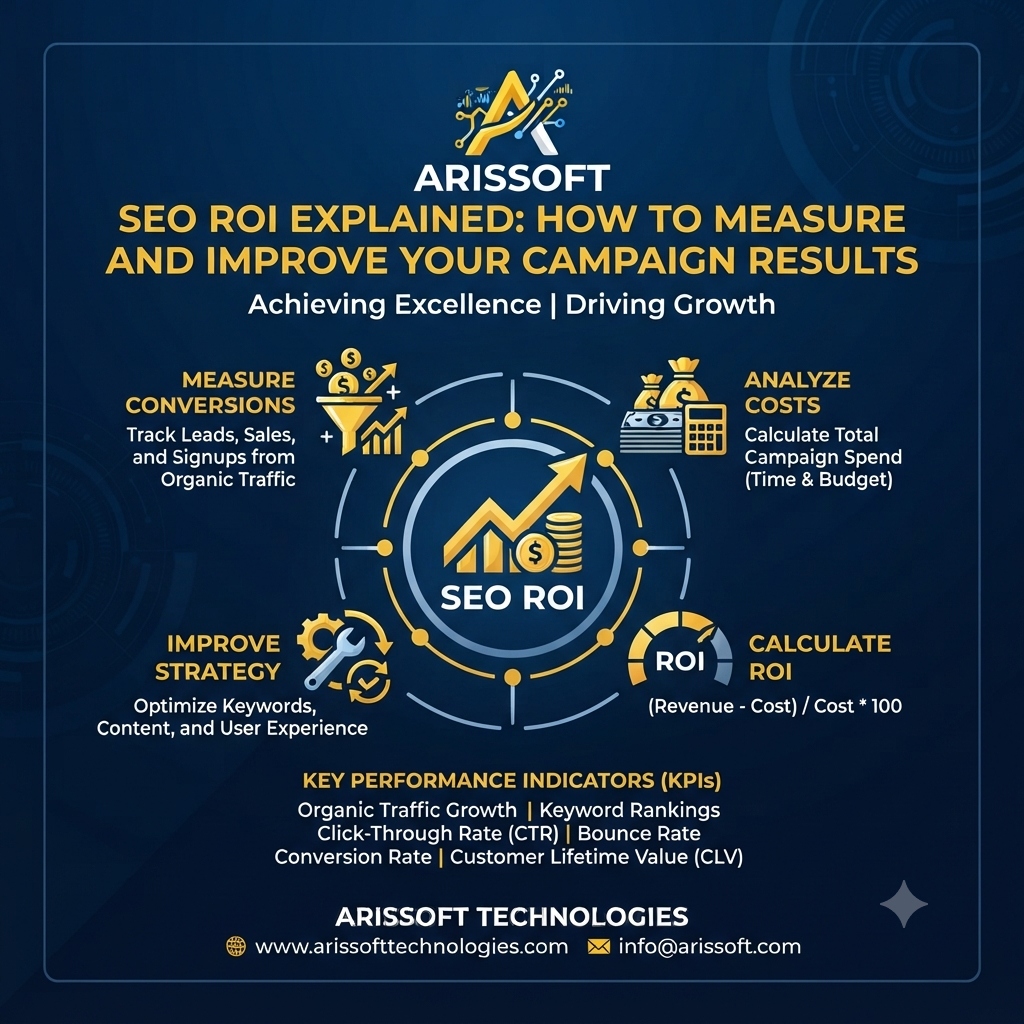
Search engine optimization is one of the most effective ways for businesses to build long-term online visibility. But ranking on Google is not the final goal. The real goal is to generate valuable traffic, leads, sales, and revenue.
This is where SEO ROI becomes important.
SEO ROI helps businesses understand whether their SEO investment is producing meaningful financial results. It shows what the company is gaining compared with what it is spending on SEO.
In this guide, we explain how to measure SEO ROI, which metrics matter, how to calculate it, and how to improve your SEO campaign results.
SEO ROI (Return on Investment) measures the financial return generated from your SEO activities compared with the amount invested in SEO.
A simple SEO ROI formula is:
SEO ROI = [(Revenue from SEO − SEO Investment) ÷ SEO Investment] × 100
For example, suppose a business spends ?50,000 on SEO in a month and generates ?1,50,000 in revenue from SEO-driven customers.
SEO ROI would be:
[(?1,50,000 − ?50,000) ÷ ?50,000] × 100 = 200%
This means the business generated ?2 in profit for every ?1 invested, before considering other business costs.
Many businesses focus only on keyword rankings. Rankings are useful, but they do not always tell you whether SEO Agency Noida is helping the business grow.
A keyword ranking in the top position is valuable only when it contributes to meaningful traffic, leads, customers, or revenue.
Measuring SEO ROI can help you:
There is no single metric that can accurately measure SEO success. A strong campaign should be evaluated using multiple performance indicators.
1. Organic Traffic
Organic traffic is the number of visitors coming to your website through unpaid search results.
You can monitor:
However, traffic alone does not guarantee business growth.
For example, getting 20,000 visitors who never contact your company may be less valuable than receiving 1,000 visitors who generate 50 qualified leads.
2. Keyword Rankings
Keyword rankings show where your website appears in search results for specific search terms.
Track important keywords related to your products, services, and target audience.
For example, a digital marketing agency might track:
Ranking improvements can indicate that your SEO strategy is moving in the right direction.
But rankings should be connected with traffic and conversions to understand their real business value.
3. Organic Leads
Lead generation is one of the most important SEO metrics for service businesses.
Track actions such as:
For example, if organic traffic increases by 30% but qualified enquiries remain unchanged, the campaign may need better keyword targeting or landing-page optimization.
4. Organic Sales and Revenue
For e-commerce businesses and companies with proper conversion tracking, revenue is one of the strongest SEO performance indicators.
You should identify:
This helps connect SEO activities directly with business outcomes.
5. Conversion Rate
The organic conversion rate tells you how many organic visitors complete a desired action.
The formula is:
Conversion Rate = (Conversions ÷ Organic Visitors) × 100
For example, if 2,000 organic visitors generate 80 enquiries:
80 ÷ 2,000 × 100 = 4%
A low conversion rate may indicate problems with your website, content, offer, page speed, user experience, or targeting.
How to Calculate SEO ROI
To calculate SEO ROI accurately, you need to understand both your investment and the revenue generated from organic search.
Step 1: Calculate Your SEO Investment
Your SEO investment may include:
Try to include all significant SEO-related expenses.
Step 2: Track Organic Conversions
Set up conversion tracking for important actions.
For example:
Website visitor → Enquiry → Qualified lead → Customer
This helps you understand how organic traffic contributes to actual business growth.
Step 3: Assign a Value to Leads
Not every business receives online sales directly.
For service businesses, SEO may generate leads that later become customers through phone calls or offline meetings.
In such cases, estimate the average value of a qualified lead.
For example:
Estimated revenue:
20 × ?30,000 = ?6,00,000
This can help you estimate the financial contribution of SEO.
Step 4: Apply the ROI Formula
Once you know your SEO-generated revenue and investment, use:
SEO ROI = [(SEO Revenue − SEO Investment) ÷ SEO Investment] × 100
This provides a simple way to evaluate campaign profitability.
SEO Metrics That Help Improve ROI
Some metrics are particularly useful for finding opportunities to improve performance.
Organic Conversion Rate
If traffic is high but conversions are low, improve your landing pages, calls to action, forms, offers, and user experience.
Cost Per Lead
Calculate how much you are effectively spending to generate each SEO lead.
Cost Per Lead = SEO Investment ÷ Number of SEO Leads
For example:
?60,000 SEO investment ÷ 100 leads = ?600 per lead
Customer Acquisition Cost
You can also calculate the approximate cost of acquiring customers through SEO.
SEO Customer Acquisition Cost = SEO Investment ÷ Customers Acquired Through SEO
This gives you a better understanding of SEO's business efficiency.
Customer Lifetime Value
For businesses with repeat customers, do not look only at the first purchase.
A customer acquired through SEO may continue buying products or services for several years.
Therefore, Customer Lifetime Value (CLV) can provide a more realistic picture of SEO's long-term value.
How to Track SEO ROI
Accurate tracking requires proper analytics and conversion measurement.
Common tools include:
Google Search Console can help you understand search queries, clicks, impressions, and search visibility.
Analytics and CRM data can then help connect website activity with leads and customers.
A common SEO mistake is measuring success only through rankings.
Suppose your website ranks #1 for a keyword that receives very little search traffic and produces no customers.
The ranking looks impressive, but its business value may be low.
On the other hand, a keyword ranking in position #4 could generate hundreds of highly relevant visitors and several customers every month.
Therefore, evaluate SEO using a combination of:
Rankings + Traffic + Engagement + Leads + Customers + Revenue
This provides a much clearer picture of campaign performance.
How to Improve Your SEO ROI
Once you start measuring ROI, the next step is improving it.
1. Target High-Intent Keywords
Not every keyword has the same commercial value.
Focus on keywords that indicate buying or enquiry intent.
For example:
These can have stronger commercial intent than broad informational searches.
2. Improve Existing High-Potential Pages
You do not always need to create new content.
Review pages that already receive impressions and traffic but rank below the top positions.
Improve them by:
Moving an existing page from page two to page one can sometimes create significant additional traffic.
3. Improve Conversion Optimization
More traffic does not automatically mean more customers.
Improve your landing pages with:
The goal is to turn more organic visitors into leads and customers.
4. Build Better Internal Links
Internal linking helps search engines understand your website structure.
It can also guide visitors toward important commercial pages.
For example, an educational SEO article can naturally link to a relevant SEO service page.
Use descriptive anchor text and make sure links are genuinely useful to the reader.
5. Improve Technical SEO
Technical problems can reduce your website's search visibility and user experience.
Review:
A technically healthy website provides a stronger foundation for SEO growth.
6. Create Content Based on Search Intent
Before creating an article, understand what the searcher wants.
Search intent can generally be:
A person searching "what is SEO" has a different intent from someone searching "best SEO company in Noida."
Your content should match the user's actual purpose.
7. Focus on Qualified Traffic
More visitors are not always better.
A business should focus on attracting people who are likely to become customers.
This means selecting keywords based on:
Relevance + Search Intent + Business Value
rather than search volume alone.
SEO ROI for Local Businesses
Local businesses can measure SEO ROI through actions such as:
For businesses targeting specific cities, Local SEO agency Noida can be particularly valuable.
For example, a clinic targeting Noida may benefit more from ranking for relevant local searches than from attracting visitors from cities where it does not provide services.
SEO ROI for E-Commerce Websites
E-commerce businesses have a major advantage because online transactions can often be tracked directly.
Important metrics include:
SEO can help e-commerce businesses attract customers without paying for every individual click.
How Long Does It Take to See SEO ROI?
SEO is generally a long-term marketing strategy.
Results can vary depending on:
Some websites may see early improvements within a few months, while competitive keywords can take considerably longer.
Therefore, businesses should evaluate SEO over time rather than expecting immediate results.
Common SEO ROI Measurement Mistakes
Avoid these common mistakes:
Measuring Only Rankings
Rankings are important but do not directly represent revenue.
Measuring Only Traffic
Large traffic numbers are meaningless if visitors are not relevant.
Ignoring Conversion Tracking
Without conversion tracking, it becomes difficult to understand which SEO activities generate business.
Ignoring Assisted Conversions
Customers may discover your business through organic search but convert later through another channel.
SEO can therefore contribute to the customer journey even when it is not the final touchpoint.
Expecting Immediate ROI
SEO usually requires consistent work and time.
Tracking Vanity Metrics
Metrics such as impressions can provide useful insights, but they should not replace business-focused measurements.
A Simple SEO ROI Dashboard
A practical monthly SEO report can include:
|
Metric |
Current Month |
Previous Month |
|
Organic Users |
10,000 |
8,500 |
|
Organic Leads |
250 |
190 |
|
Qualified Leads |
120 |
90 |
|
Customers |
35 |
28 |
|
Organic Revenue |
?7,00,000 |
?5,20,000 |
|
SEO Investment |
?1,00,000 |
?1,00,000 |
|
Estimated SEO ROI |
600% |
420% |
The exact metrics should be customized according to the business model.
Final Thoughts
SEO ROI is about more than rankings and website traffic. It is about understanding how SEO contributes to real business growth.
A successful SEO campaign should connect search visibility with qualified traffic, leads, customers, and revenue.
Start by setting clear goals, implementing accurate conversion tracking, measuring organic performance, and calculating your return on investment regularly.
Then use the data to improve keyword targeting, content, landing pages, technical SEO, internal linking, and conversion rates.
When SEO is measured as a business investment rather than simply a ranking activity, it becomes much easier to identify what is working, control costs, and improve campaign results over time.
 Which Website Development Company in Noida Is Right for Your Business to Grow Online?
 How Can a Digital Marketing Company in Noida Help Grow Your Business?
 Digital Marketing Service in Noida: How to Choose the Right Services for Your Business
 How to Find the Best Digital Marketing Company in Noida: A Complete Business Guide
 Top 5 Leading Digital Marketing Companies in Noida for Business Growth
 Top Benefits of SEO Services – Boost Your Online Presence and Business Growth

.jpg)